How Does TCM View Gout?
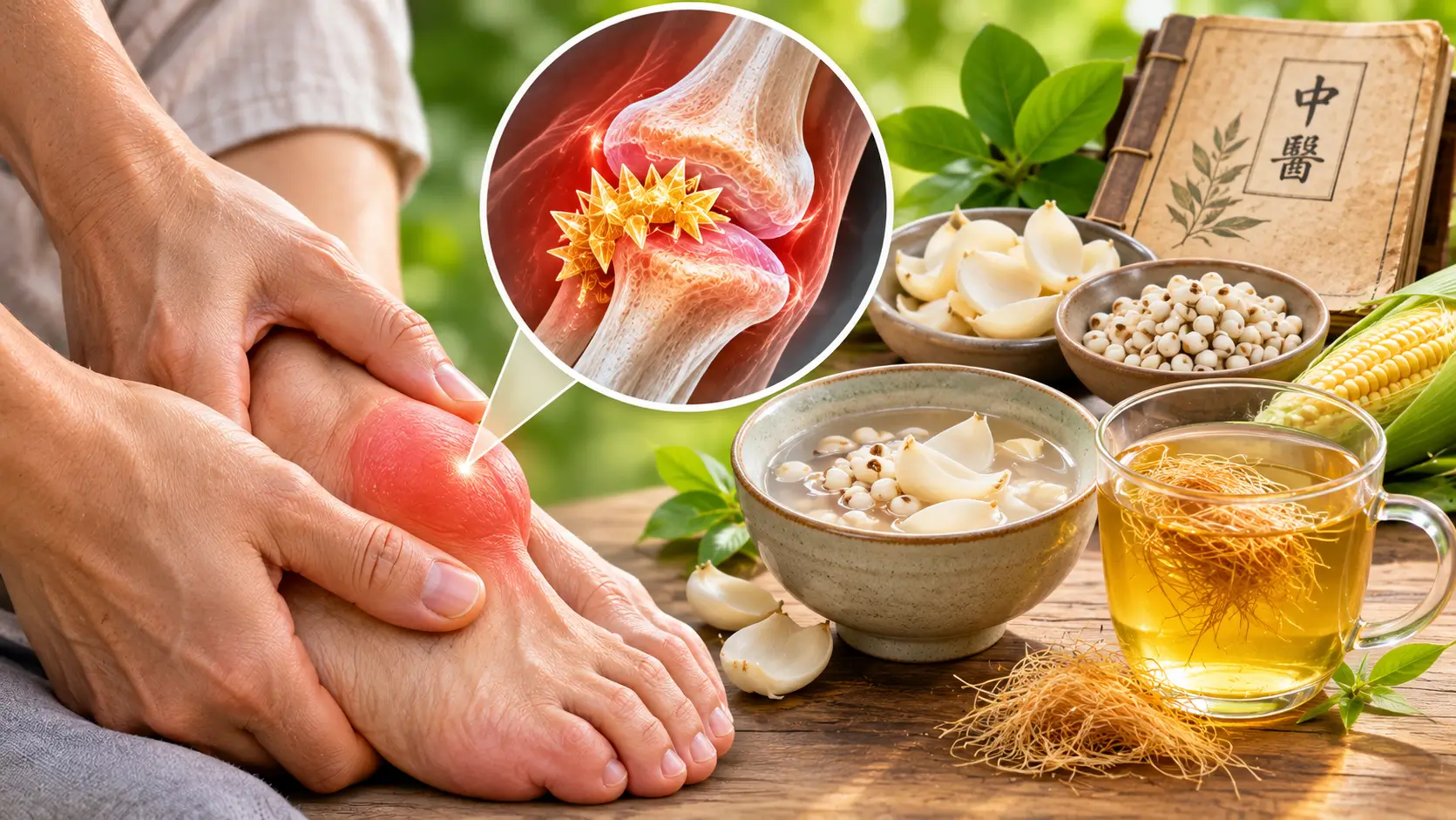
Gout occurs when uric acid crystals accumulate in the joints, causing painful inflammation. Traditional Chinese medicine emphasizes individual constitution, dietary balance, and lifestyle adjustments as part of holistic health management.
Gout may seem like a minor form of arthritis, but when it flares, the pain can feel like a tiger biting into your bones. More than two thousand years ago, Chinese medical texts such as the Waitai Miyao (Arcane Essentials From the Imperial Library) recorded this condition and called it “white tiger joint pain,” describing pain like a tiger’s bite that penetrates the joints. It was also known as a “disease of the wealthy,” often caused by a diet of rich, fatty, sweet foods. Modern medicine identifies the root of gout as excess uric acid in the blood: uric acid crystals deposit in the joints and cause intense pain.
1. Gout Through the Eyes of TCM
Traditional Chinese Medicine (TCM) classifies gout as a “bi syndrome.” “Bi” means blockage: qi and blood cannot flow smoothly and the meridians are obstructed. When pathogenic wind, cold, dampness or heat invades the joints, qi and blood are blocked, and as TCM says, “where there is blockage, there is pain.” This leads to joint pain, redness, swelling and limited movement.
2. What Causes Gout
Modern medicine links gout to genetics, high uric acid (hyperuricemia), obesity, heavy drinking and a high-purine diet. TCM divides the causes of gout into external and internal factors. External factors are pathogenic wind, cold, dampness and heat invading the body and blocking the meridians. Internal factors mostly come from irregular eating, overwork and a weak constitution. Over time, phlegm-dampness and blood stasis bind together, blocking the flow of qi and blood and causing recurring pain.
3. The Four TCM Patterns of Gout
TCM emphasizes treatment based on pattern differentiation. Depending on the person’s constitution, gout generally falls into four types:
1. Damp-Heat Type:
Red, swollen, burning joints, thirst, and scanty dark urine. Sanmiao San combined with Danggui Niantong Tang may be used to clear heat, drain dampness, open the channels and relieve pain.

2. Cold-Damp Type:
Joint pain that worsens with cold, aching as if the bones were frozen. Wutou Tang may be used to warm the channels, dispel cold, remove dampness and relieve pain.
3. Phlegm-Stasis Type:
Deformed joints and a dark purple tongue. Erhe Tang may be used to resolve phlegm, disperse stasis, open the channels and relieve pain.
4. Liver and Kidney Deficiency Type:
Long-lasting joint pain that won’t heal, weak and aching lower back and knees, and muscle wasting. Duhuo Jisheng Tang is used to tonify the liver and kidneys, open the channels and relieve pain.
4. Two TCM Food Therapy Recipes: Lily Bulb and Job’s Tears Soup and Corn Silk Tea
1. Lily Bulb and Job’s Tears Soup
Ingredients: 15 g lily bulb, 30 g Job’s tears (coix seed)
Method: Put the lily bulb and crushed Job’s tears in a pot with 6 bowls of water and simmer until reduced to 2 bowls. Eat the soup together with the ingredients. Research has found that coix seed oil can lower serum uric acid levels. Note: people with a cold, weak digestive system or who urinate frequently at night should use caution.
2. Corn Silk Tea
Ingredients: 30 g corn silk
Method: Rinse the corn silk, put it in a pot with 1000 ml of water and boil for 10 minutes. In TCM, corn silk is sweet and bland in taste and neutral in nature, and enters the kidney, bladder, liver and gallbladder meridians. It promotes urination, reduces swelling and clears heat.
5. Daily Diet and Lifestyle Care for Gout
Modern medicine considers gout a chronic metabolic disease caused by disordered purine metabolism, which leads to uric acid crystal buildup. In daily life, you can support metabolism by eating fewer high-purine foods (such as organ meats, seafood and rich broths), drinking more water and exercising moderately to help your body excrete uric acid. You can also consider daily nutritional supplements such as Herbtail GlucoMetabol to support metabolic balance.
Please note that the herbs and dietary supplements mentioned above should be used as part of a comprehensive plan under the guidance of a qualified practitioner.